Choosing an executive search firm comes down to five factors: who personally leads the search, how the firm defines the mandate before entering the market, how it reaches leaders who are not actively looking, how it evaluates finalists, and how much visibility you have from start to finish. A firm worth retaining answers each of these clearly and puts a senior partner accountable for the outcome.
Business-critical leadership hires shape strategy, governance and reputation for years. When one goes wrong, the cost is financial, public and slow to correct. The search firm you select is the first decision in that hire, and it deserves the same discipline as the appointment itself.
Most executive hiring problems start before a single candidate is contacted. They start with a vague mandate, a narrow search or an inconsistent evaluation. The right partner prevents all three.
This guide gives boards, CEOs and CHROs a practical framework for the decision: what a search firm should deliver, when to engage one, the questions that separate disciplined firms from transactional ones, and the red flags to watch for.
What Does an Executive Search Firm Do?
An executive search firm identifies, assesses and secures leaders for roles that carry strategic, financial or reputational weight. Typical mandates include CEO, CFO, COO, CHRO, executive director, vice president and other business-critical positions.
A disciplined firm delivers four things an internal team or job posting cannot. It aligns stakeholders on what the role must deliver. It reaches qualified leaders through full-market outreach. It evaluates every candidate against the same criteria. It gives decision-makers the market insight and structured candidate information they need to hire with confidence.
What Is the Difference Between Retained and Contingency Search?
Retained firms are engaged exclusively on a single search and paid in stages as the work progresses. Contingency firms are paid only when their candidate is hired, and they often compete against other agencies for the same role.
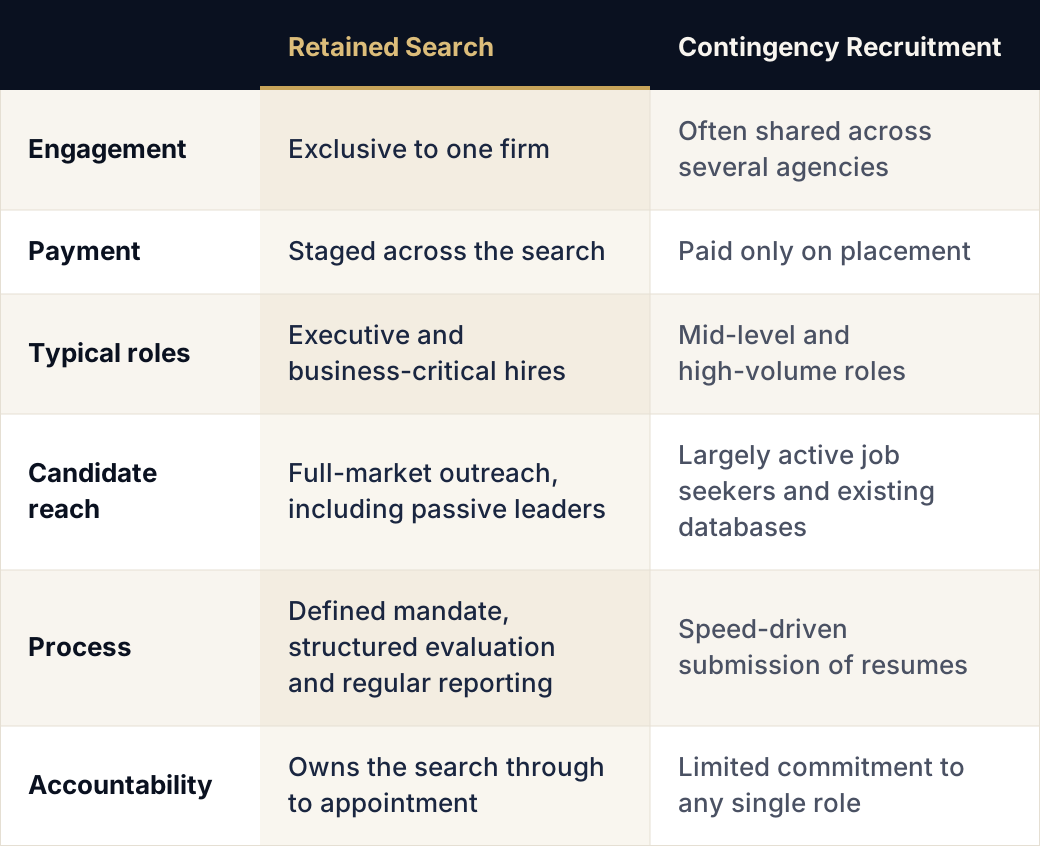
For executive and business-critical roles, retained search is the standard. Exclusivity gives the firm the time and accountability to map the full market, evaluate rigorously and see the search through to appointment.
When Should an Organization Hire an Executive Search Firm?
Bring in a retained search firm when a hire carries real consequence and the decision has to hold up under scrutiny. The most common triggers:
- A CEO or C-suite succession. The board needs an independent, defensible process it can stand behind.
- A confidential search. The incumbent is still in the role, or the organization cannot signal the vacancy publicly.
- A first-of-its-kind role. The organization is creating a new position and has no internal benchmark for what good looks like.
- A transformation mandate. The leader will drive a turnaround, merger integration, growth phase or major change in strategy.
- Conflicted or limited networks. Internal referrals are insufficient, too close to the organization, or likely to raise questions of bias.
- A previous search that failed. An earlier attempt produced a weak shortlist or a hire who did not last.
When two or more of these apply, a retained search partner lowers your risk.
9 Questions to Ask When Evaluating an Executive Search Firm
Bring these questions to your first meeting with every firm on your shortlist. The answers show you quickly how disciplined, accountable and transparent each firm will be once the search is underway.
1. Who will personally lead and run the search?
Get a name. Then ask how much of the work that person does themselves. Some firms win mandates with a senior partner and hand the search to junior researchers. On an executive search, the person who pitches the work should run it, speak with candidates and present the shortlist.
2. How will you define the mandate before going to market?
Most failed executive searches trace back to an unclear mandate. A disciplined firm interviews key stakeholders, aligns them on the outcomes the leader must deliver, and sets evaluation criteria before any outreach begins. Ask to see a sample mandate document.
3. How will you reach leaders who are not actively looking?
The strongest candidates for senior roles are employed, performing and not applying for jobs. Ask how the firm calibrates the market, which organizations and sectors it will target, and how it approaches passive candidates confidentially. A firm that leans on job postings and its existing database will hand you a narrow shortlist.
4. How do you evaluate candidates?
Ask the firm to walk you through its evaluation framework step by step. Look for structured interviews against agreed criteria, consistent scoring, thorough referencing and written candidate assessments. Consistency makes the final decision defensible to your board, your staff and your stakeholders.
5. What visibility will we have during the search?
Ask how often you will hear from the firm, what each update covers and who delivers it. Expect a fixed reporting cadence covering market response, pipeline status, candidate feedback and any change in strategy. You should never have to chase your search firm for progress.
6. What are your off-limits and conflict-of-interest policies?
Search firms agree not to recruit from their current clients. The more clients a firm serves in your sector, the fewer organizations it can approach on your behalf. Ask for the off-limits list and how it narrows your search.
7. Do you specialize in our industry, or do you search across sectors?
Sector specialists know one market well. Cross-sector firms bring a broader hunting ground, fewer off-limits restrictions and access to leaders whose skills transfer from adjacent industries. The competencies that define most leadership roles, including governance, change leadership, financial stewardship and stakeholder management, show up across sectors. Decide which matters more for this hire.
8. How is the fee structured?
Retained fees are calculated as a percentage of first-year cash compensation or set as a fixed fee, and paid in instalments across the search. Ask exactly what the fee covers, when each payment is due, and whether expenses, assessments or advertising are billed separately. A fixed, transparent fee removes any incentive to push compensation higher.
9. What happens if the placement does not work out?
Ask about the replacement guarantee: how long it lasts, what conditions apply, and whether the firm will run a new search at no additional fee. A firm that trusts its evaluation process puts that commitment in writing.
What Should Boards, CEOs and CHROs Each Look For?
Each stakeholder carries a different accountability in an executive hire. The right firm serves all three.
Boards of Directors
Boards own governance, succession and long-term direction. For a CEO or executive search, boards should look for:
- An independent process that holds up under scrutiny from members, funders, regulators and the public
- A documented mandate, evaluation criteria and decision rationale
- Direct experience with board search committees, including managing differing views among directors
- Strict confidentiality, especially while an incumbent is still in the role
CEOs
CEOs hiring into their leadership team need someone who can execute the strategy and strengthen the team around them. CEOs should look for:
- A firm that learns the strategy, operating model and team dynamics before it goes to market
- Direct market feedback on how the role, organization and compensation will land with candidates
- A shortlist drawn from the full market, including leaders from adjacent sectors
- A senior partner who challenges assumptions and gives a clear view on every finalist
CHROs
CHROs manage the search relationship and protect the integrity of the process. CHROs should look for:
- A structured evaluation framework consistent with internal hiring standards
- Predictable reporting with clear pipeline data
- A candidate experience that strengthens the organization's employer brand
- Support through offer, negotiation and transition into the role
Red Flags When Choosing an Executive Search Firm
Push back hard, or walk away, if a firm shows any of these signs:
- The senior partner disappears after the pitch. Junior staff you never met run the search.
- There is no mandate definition stage. The firm wants to source before stakeholders agree on what the role must deliver.
- Resumes arrive within days. Speed like that signals a recycled database.
- Answers on evaluation are vague. The firm cannot explain how it assesses candidates or compares them consistently.
- There is no committed reporting cadence. Updates only come when you ask.
- Off-limits restrictions are unclear. The firm cannot name the organizations it is unable to approach.
- The firm guarantees a timeline. No credible firm promises an appointment date before it has tested the market.
- The firm pressures you to compromise. It steers you toward available candidates over the agreed profile.
How Oxford + Richmond Approaches Executive Search
Oxford + Richmond is a Canadian retained executive search firm for leadership and business-critical hires. We are recognized among Hunt Scanlon's Top 250 Executive Search Firms in North America and Top 60 Canadian Executive Search Firms.
Every search we run follows the same disciplined framework:
- Mandate Definition. We align stakeholders, define role expectations and establish evaluation criteria before entering the market.
- Market Calibration & Targeted Outreach. We identify and engage leaders beyond traditional applicant channels, including passive candidates who are not pursuing new roles.
- Structured Evaluation. We assess every candidate against the same criteria to reduce decision risk and support a defensible outcome.
- Candidate Insights & Alignment. We give decision-makers structured candidate insight and keep stakeholders aligned through to the final decision.
- Visibility & Decision Support. We maintain a consistent reporting cadence, share market insight, and provide guidance through offer and transition.
Our searches are senior-led from mandate to appointment. We search across sectors, which gives clients a broader hunting ground, fewer off-limits conflicts and objective benchmarking. We are retained so we do not cut corners.
Preparing for a business-critical hire? Talk to Oxford + Richmond about your search.
Frequently Asked Questions
How long does an executive search take? Most retained executive searches take three to six months from mandate definition to accepted offer. Seniority, market size, stakeholder availability and the candidate's notice period all shape the timeline.
How much does an executive search firm cost? Retained executive search fees are set as a percentage of the role's first-year cash compensation or as a fixed fee, paid in stages across the search. Ask every firm for a written breakdown of what the fee covers and which expenses are billed separately.
How many executive search firms should we interview? Interview two to four firms. That gives you a real comparison of process, approach and fit without delaying the search.
Should a board use the same search firm the organization already works with? Yes, if the firm has no conflicts and can run an independent process. For CEO searches, boards benefit from a firm with no prior relationship to the outgoing CEO or the internal candidates. That independence strengthens the decision.
What is the difference between an executive search firm and a recruitment agency? An executive search firm is retained exclusively to find and assess senior leaders through direct outreach to passive candidates. A recruitment agency fills mid-level and high-volume roles on contingency, drawing mostly from active job seekers.
Does an executive search firm need experience in our industry? Sector experience helps. Transferable leadership competencies matter more. Cross-sector firms bring broader market access, fewer off-limits restrictions and leaders whose experience in adjacent industries strengthens the shortlist.
What should be included in an executive search agreement? A strong agreement sets out the role and scope, the fee and payment schedule, expenses, reporting cadence, off-limits restrictions, confidentiality terms and the replacement guarantee.